Africa Has the ML Talent But Missing the GPUs.
One challenge I have noticed throughout my academic journey and as a TA is that access to computing resources, especially GPUs, has become a major bottleneck for many students especially here in Africa and young researchers working on machine learning.
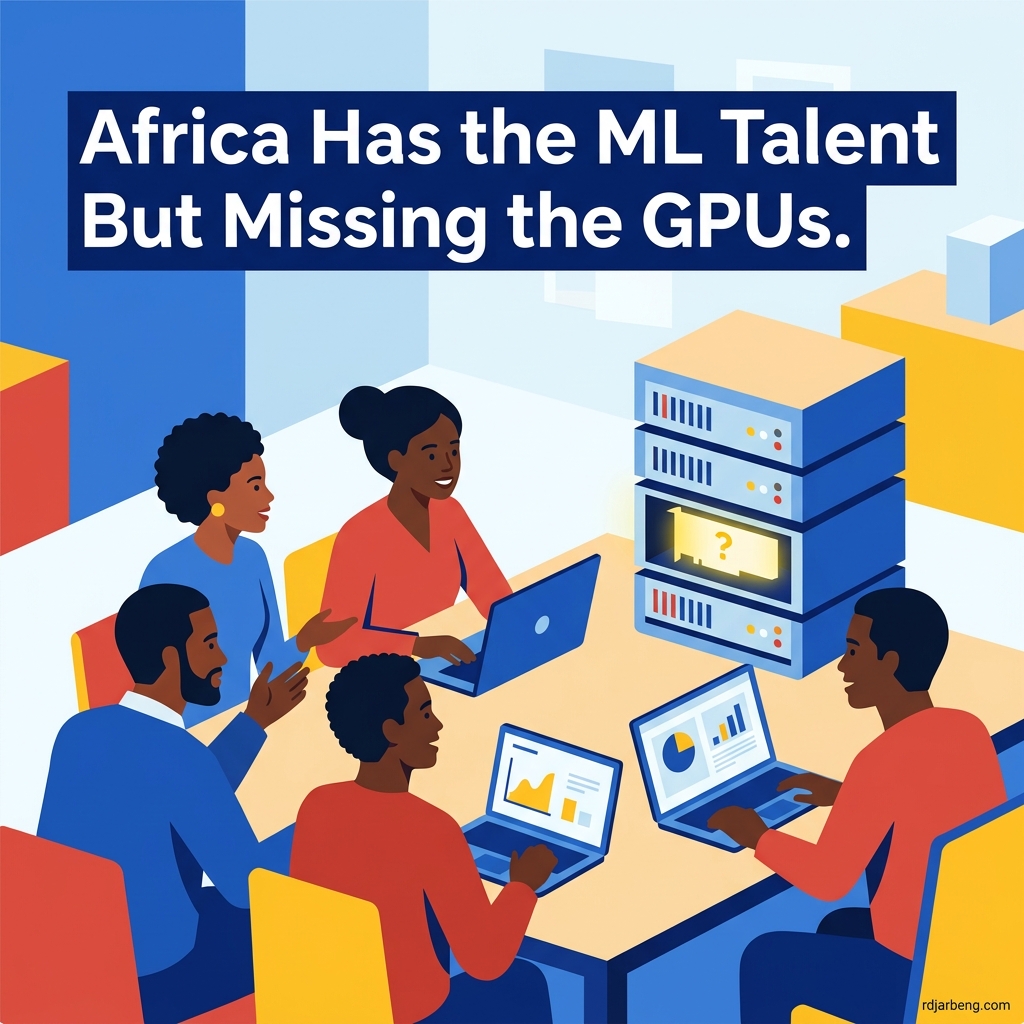
This challenge is very visible in fields like computer vision, where training and experimenting with deep learning models can require significant computational power. Many students have great ideas and strong technical skills, but when it comes to the experimental phase of their thesis or research projects, they are often forced to reduce the number of experiments, use smaller models, or rely on heuristic analysis, not because those approaches are scientifically ideal, but because the required computing resources are simply out of reach.
This is a problem that exists quietly within many academic institutions, especially in universities and research institutions where access to high-performance computing infrastructure is just a dream at the moment. It is also a challenge I have personally experienced.
The Limits of Current Alternatives
A common alternative has been to rely on platforms such as Google Colab or Kaggle notebooks, which have been extremely valuable in democratizing access to computational resources. However, they are not always designed for large-scale research projects. Runtime limitations, unexpected disconnections, loss of outputs, challenges with managing large datasets and files, and the lack of a seamless development environment can make it difficult to build and maintain complex research workflows.
A Possible Solution
This leads me to think about a possible solution: what if we could create affordable mini high-performance computing (HPC) clusters or a dedicated low-cost cloud computing platform designed specifically for students and researchers in many African institutions?
The goal would not be to compete with large cloud providers like AWS or Google Cloud, but to provide accessible and reliable GPU computing for academic research, something that allows students to run experiments, train larger models, and explore ambitious ideas without computational limitations becoming the deciding factor.
Why This Matters
I believe research potential should not be limited by who can afford expensive GPU hours. Access to computing power should become an enabler of innovation, especially for young researchers who are trying to solve important problems with limited resources.
This is an idea I have been thinking about for some time, and I hope to contribute to building solutions around this challenge in the future. I would love to hear from researchers, engineers, and organizations who have experienced similar challenges or are exploring ways to make computing more accessible.
Up next: Part 3 of 6 in The Cost of AI Compute

Geographic Concentration of Machine Learning Models: How Compute Economics Re-Engineered the AI Map
When you look at where notable artificial intelligence models come from, the global map looks empty. In the 2024 Stanford AI Index Report, researchers tracked 149 notable machine learning systems...
Related Concepts & Posts
The following cards provide further definitions of concepts discussed above, and possible links to related posts.
GPU (Graphics Processing Unit)
A GPU is a specialized chip originally built for rendering graphics, now widely used to train machine learning models because it can run thousands of calculations at once. Deep learning tasks that would take days on a regular computer processor can often run in hours on a GPU.
Learn MoreGoogle Colab
Google Colab is a free, cloud-based notebook environment that gives users temporary access to GPUs for running Python code, popular with students because no local hardware or setup is required. It has usage limits and can disconnect during long-running tasks.
Visit ColabKaggle Notebooks
Kaggle is a data science community that also offers free notebooks with GPU access, similar to Google Colab. It is commonly used for machine learning competitions, datasets, and experimentation.
Visit KaggleHPC (High-Performance Computing)
HPC refers to clusters of powerful, interconnected computers used to run large-scale computations far beyond what a single machine can handle. Universities and research labs with HPC access can train larger models and run more experiments in parallel.
Learn More