The Right AI Model for the Job: A Practical Guide
Not all AI models are built the same. Some excel at reasoning through complex logic puzzles, while others are masterfully tuned to transcribe audio with near-human accuracy. Matching the model to the task from the outset avoids unnecessary complexity, sluggish performance, and bloated infrastructure costs later.
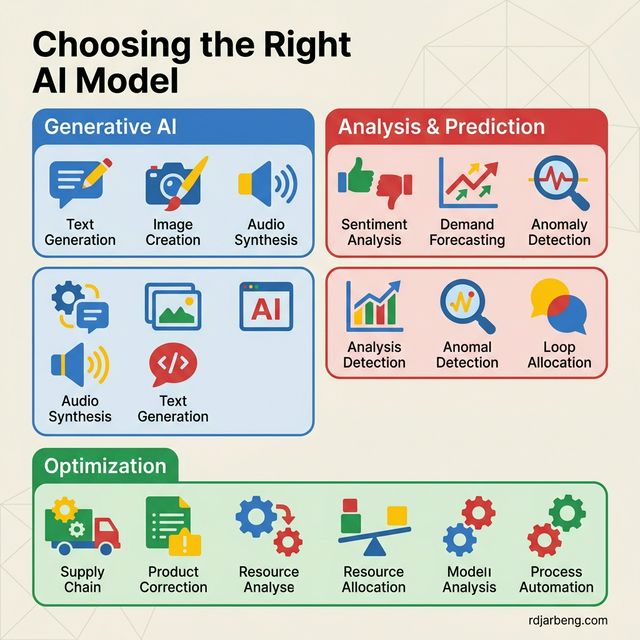
Quick Reference Matrix
Use this matrix to quickly identify which model architectures support the specific capabilities your application needs.
| Model | Reasoning | Function Calling | TTS | STT | Multilingual | Vision |
|---|---|---|---|---|---|---|
| GPT OSS 120B | ✅ | ✅ | ✅ | |||
| GPT OSS 20B | ✅ | ✅ | ✅ | |||
| Llama 4 Scout | ✅ | ✅ | ✅ | |||
| Llama 3.3 70B | ✅ | |||||
| Qwen 3 32B | ✅ | ✅ | ||||
| Orpheus English | ✅ | |||||
| Orpheus Arabic Saudi | ✅ | |||||
| Whisper Large v3 | ✅ | ✅ | ||||
| Whisper Large v3 Turbo | ✅ |
A Quick Primer for Non-Technical Readers
If you are new to the AI space, you will see a lot of numbers and acronyms below. Here is a quick cheat sheet:
-
Parameters (e.g., 20B, 120B):
Think of parameters as the “synapses” in an AI’s brain. The “B” stands for billions. A 120B model is massive and highly intelligent, but requires expensive supercomputers to run. A 20B model is smaller, faster, and cheaper to operate.
-
The “Labs”:
Just like cars have manufacturers (Toyota, Ford), AI models are built by specific research labs. You will see models below developed by OpenAI (the creators of ChatGPT), Meta (the parent company of Facebook), Alibaba Cloud, and specialized audio startups like Canopy Labs.
Here is a breakdown of the exact tasks different AI models are best suited for, grouped by their core functions.
Reasoning
Reasoning models don’t just spit out the first word that comes to mind. They “think” through a problem step-by-step, making them highly capable in mathematics, coding, and logical deduction.
The Models:
- GPT OSS 120B (OpenAI): A massive open-source model released by OpenAI. At 117 billion parameters, it has the depth required to handle highly complex, multi-hop reasoning tasks with near-frontier accuracy.
- GPT OSS 20B (OpenAI): The leaner, faster sibling to the 120B model. It offers solid reasoning capabilities but is small enough to run on consumer hardware or edge devices.
- Qwen 3 32B (Alibaba Cloud): Alibaba’s highly competitive open-source model. It features a unique hybrid “Thinking Mode” that forces the AI to deliberately plan out its logic before answering, making it exceptionally strong at complex math and coding.
Real-World Use Cases:
- Complex Code Debugging: Instead of just writing code, the AI acts as a senior engineer, reading a broken script and logically deducing why it is failing.
- Strategic Planning: Asking the AI to evaluate a business scenario, weigh the pros and cons, and generate a multi-step execution plan.
- Advanced Mathematics: Solving physics equations or data science problems that require sequential logic.
Function Calling / Tool Use
These models are trained to be “Agentic.” Instead of just talking to you, they can reliably identify when they need to trigger external software (like searching the web, checking a database, or sending an email) to get the job done.
The Models:
- GPT OSS 120B & 20B (OpenAI): Both OpenAI models are heavily optimized for executing code environments and constructing exact JSON payloads needed to trigger external APIs.
- Llama 4 Scout (Meta): A 17-billion parameter “Mixture-of-Experts” model from Meta’s Llama 4 family. It is incredibly efficient and natively strong at selecting tools and executing multi-step workflows.
- Qwen 3 32B (Alibaba Cloud): Qwen 3 excels at tool invocation, particularly in scenarios where it needs to reason deeply about which tool to use before taking action.
Real-World Use Cases:
- Autonomous AI Agents: Building a bot that can read a user’s prompt, realize it needs current weather data, ping a weather API, and return the result.
- Database Querying: Allowing users to ask questions in plain English, while the AI translates that question into SQL to fetch data directly from a company database.
Text to Speech (Audio Generation)
These models turn written text into natural-sounding human audio.
The Models:
- Orpheus English (Canopy Labs): A specialized “Speech-LLM” built to generate English speech. Unlike older robotic voices, Orpheus understands emotional context and generates empathetic, highly natural human prosody.
- Orpheus Arabic Saudi (Canopy Labs): The same advanced architecture adapted specifically for Saudi Arabic, ensuring dialect-specific pronunciation and natural cultural inflections that generic models often miss.
Real-World Use Cases:
- Audiobook Narration: Generating expressive, emotion-driven audio for long-form content.
- Accessibility Tools: Giving a natural, pleasant voice to screen readers for visually impaired users.
- Customer Service Bots: Powering voice assistants that sound friendly and conversational rather than robotic.
Speech to Text (Transcription)
These models listen to audio files or live speech and convert them into highly accurate text transcripts.
The Models:
- Whisper Large v3 (OpenAI): The industry standard for open-source speech recognition. It powers through heavy background noise and thick accents to deliver incredibly accurate transcripts.
- Whisper Large v3 Turbo (OpenAI): A highly optimized version of Whisper that trades a tiny fraction of accuracy for blistering fast processing speeds.
Real-World Use Cases:
- Meeting Transcriptions: Automatically generating text logs of Zoom or Teams meetings.
- Video Captioning: Creating highly accurate subtitles for YouTube videos or films.
- Live Voice Commands: Allowing users to speak to an app in real-time (ideal for the faster “Turbo” model).
Text to Text (General Generation)
This is the classic “ChatGPT” use case. These models are great all-rounders for generating, summarizing, and rewriting plain text.
The Models:
- Llama 3.3 70B (Meta): A highly established, reliable baseline model from Meta. It is widely used by developers for general content generation and instruction following.
- GPT OSS 120B & 20B (OpenAI): Both models serve as excellent general chat assistants, with the 20B model providing a fast, cost-effective solution for high-throughput text pipelines.
- Llama 4 Scout (Meta): Very competitive at document summarization and content extraction.
Real-World Use Cases:
- Content Creation: Drafting emails, writing blog posts, or generating marketing copy.
- Summarization: Taking a 50-page legal document and condensing it into a one-page executive summary.
- Customer Support Chatbots: Handling standard FAQ conversations with users on a website.
Vision (Multimodal)
Vision models have “eyes.” They can look at images, screenshots, or video frames and understand what is happening inside them.
The Models:
- Llama 4 Scout (Meta): A natively multimodal model. Because vision was built into its architecture from the ground up (rather than bolted on later), it is exceptionally good at image reasoning, identifying objects, and reading text within pictures.
Real-World Use Cases:
- Document Understanding: Reading charts, graphs, and scanned PDF invoices.
- UI to Code: Showing the AI a screenshot of a website design and having it write the HTML/CSS to build it.
- Accessibility Captioning: Automatically describing images for visually impaired web users.
Multilingual
These models have been trained on diverse global datasets, allowing them to understand and generate text in dozens of different languages fluently.
The Models:
- Llama 3.3 70B & Llama 4 Scout (Meta): Meta’s models are renowned for their broad language support, making them excellent for international products.
- GPT OSS 120B & 20B (OpenAI): Both handle a wide range of global languages with high fluency.
- Whisper Large v3 (OpenAI): Not only can it transcribe audio in dozens of languages, but it can also translate spoken foreign audio directly into English text.
Real-World Use Cases:
- Real-Time Translation: Translating user chat messages dynamically in a global gaming lobby.
- Global Customer Support: Allowing a bot to seamlessly switch from English to Spanish to Japanese depending on the user’s input.
Safety & Content Moderation
These models are specifically fine-tuned to act as guardrails, ensuring that AI applications remain safe, polite, and compliant with guidelines.
The Models:
- Safety GPT OSS 20B (OpenAI): A specialized, safety-aligned version of the GPT OSS 20B model. It is designed specifically to evaluate text, detect harmful content, and enforce application guidelines.
Real-World Use Cases:
- Community Moderation: Automatically reading forum posts or social media comments and hiding toxic, abusive, or spammy content.
- Prompt Filtering: Acting as a shield in front of other AI models to ensure users cannot “jailbreak” the system or generate harmful outputs.