The Six Levels of Autonomous Driving: Architecture, Liability, and the Practical Realities of SAE Levels 0 to 5
Decoding Autonomy: Architecture, Liability, and the Practical Realities of SAE Levels 0 to 5
Public discourse around autonomous mobility frequently conflates driver-assistance software with genuine driverless capability. Much of this confusion stems from aggressive consumer marketing that labels supervised driver-assist suites as "self-driving" or "autopilot."
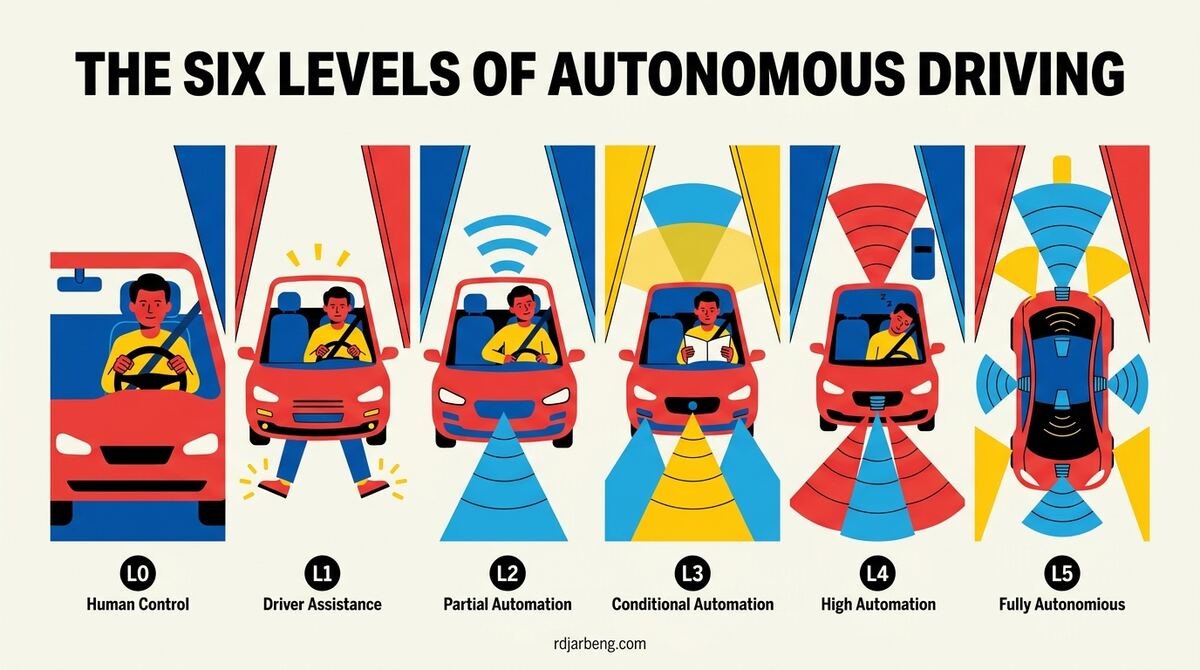
To eliminate ambiguity, the global automotive and regulatory engineering community relies on the formal taxonomy established by SAE International in standard J3016 (harmonized internationally as ISO/SAE PAS 22736:2021). Adopted by the National Highway Traffic Safety Administration (NHTSA) and the United Nations Economic Commission for Europe (UNECE), this framework does not classify vehicle intelligence by marketing buzzwords. Instead, it gauges two concrete engineering and legal metrics:
- Who controls the Dynamic Driving Task (DDT)? Specifically, who executes the real-time operational maneuvers (steering, braking, throttle) and tactical maneuvers (lane changing, gap selection, signaling), and who monitors the driving environment (Object and Event Detection and Recognition, or OEDR)?
- Who carries ultimate legal and operational liability when an edge case or collision occurs? Does liability rest with the human seated in the cabin, or does it legally shift to the manufacturer and the autonomous software stack?
Crucially, SAE J3016 draws a bright red line between two distinct categories:
- Levels 0 through 2: Driver Support Systems (ADAS). The human is always legally the driver of record, must continuously supervise the environment, and remains responsible for performing the DDT fallback at every microsecond.
- Levels 3 through 5: Automated Driving Systems (ADS). When engaged within its designated domain, the machine is legally in command of the entire Dynamic Driving Task, and the automated system handles the DDT fallback.
Understanding how responsibility migrates from the human steering wheel to the silicon compute stack reveals both the present state of commercial fleets and the roadmap for modern urban transit.
The SAE J3016 Automation Architecture Matrix
+-------+-------------------------+--------------------+---------------------+--------------------+--------------------+-------------------------+
| Level | Formal SAE Category     | Lateral/Longit.    | Environment Monitor | DDT Fallback       | Legal Liability    | Commercial Status       |
|       |                         | Actuation (DDT)    | (OEDR)              | (Intervention)     |                    |                         |
+-------+-------------------------+--------------------+---------------------+--------------------+--------------------+-------------------------+
| L0    | No Driving Automation   | Human              | Human               | Human              | Human              | Ubiquitous (AEB, FCW)   |
| L1    | Driver Assistance       | Shared (1 axis)    | Human               | Human              | Human              | Ubiquitous (ACC or LKA) |
| L2    | Partial Automation      | Machine (2 axes)   | Human (Must watch)  | Human              | Human              | Mass Market (Autopilot) |
+-------+-------------------------+--------------------+---------------------+--------------------+--------------------+-------------------------+
| L3    | Conditional Automation  | Machine            | Machine             | Human (on TOR)     | Manufacturer (ADS) | Certified (Drive Pilot) |
| L4    | High Automation         | Machine            | Machine             | Machine (Auto MRC) | Fleet / Operator   | Scaled (Waymo, ADASTEC) |
| L5    | Full Automation         | Machine            | Machine             | Machine (Anywhere) | Manufacturer       | Research Frontier       |
+-------+-------------------------+--------------------+---------------------+--------------------+--------------------+-------------------------+
The Supervised Tiers (Levels 0 to 2): Machine Support Under Human Liability
Levels 0 through 2 represent Advanced Driver Assistance Systems (ADAS). In all three tiers, the human seated in the driver's cabin remains legally in command at every microsecond.
Level 0: No Driving Automation
The vehicle's electronic control units (ECUs) do not continuously actuate steering or acceleration. The platform only issues sensory warnings or momentary emergency interventions:
- Sensory alerts: Blind Spot Information Systems (BLIS), Lane Departure Warning (LDW), Forward Collision Warning (FCW).
- Momentary actuation: Automated Emergency Braking (AEB) and Electronic Stability Control (ESC). Because AEB only activates for fractions of a second to mitigate an imminent crash, it does not constitute sustained longitudinal automation under SAE definitions.
Level 1: Driver Assistance
The system provides continuous automated execution of a single control axis (either longitudinal or lateral) while the human driver executes the other:
- Longitudinal assistance: Standard Adaptive Cruise Control (ACC) modulating throttle and braking to maintain time-gap headway.
- Lateral assistance: Lane Keeping Assist (LKA) providing torque nudges to prevent roadway departure.
- The human remains responsible for all visual scanning, mirror checks, and steering input on the non-automated axis.
Level 2: Partial Automation
The hardware simultaneously executes lateral lane-centering and longitudinal speed modulation. Common commercial implementations include Tesla Autopilot and "Full Self-Driving (Supervised)", General Motors Super Cruise, Ford BlueCruise, and BMW Driving Assistant Professional.
       +--------------------------------------------------------+
       |               LEVEL 2 SYSTEM BOUNDARY                  |
       |                                                        |
       |    +-------------------+      +-------------------+    |
       |    |  Lane Centering   |      |  Adaptive Cruise  |    |
       |    |  (Lateral Axis)   |  +   |  (Longitudinal)   |    |
       |    +-------------------+      +-------------------+    |
       |              |                          |              |
       |              +------------+-------------+              |
       |                           |                            |
       |                           v                            |
       |          Continuous Real-Time Actuation                |
       +--------------------------------------------------------+
                                   |
         BUT THE DRIVER MUST CONTINUOUSLY MONITOR:
         [ Human Eyes on Road ] <---> [ Human Hands Ready ]
         * Legal liability: 100% human driver at all times
While Level 2 systems can create the visceral sensation of autonomous navigation, their operational safety model depends entirely on continuous human vigilance. Research from the MIT Advanced Vehicle Technology (MIT-AVT) Consortium has empirically documented the dangers of partial automation:
- In a landmark study on naturalistic glance behavior around Tesla Autopilot disengagements (Morando, Gershon, Mehler, & Reimer, 2021), researchers found that drivers exhibit significantly higher rates of off-road glances toward the central touch screen and personal devices when Level 2 features are engaged compared to manual driving.
- Crucially, Morando et al. (2020) discovered that in 33% of driver-initiated disengagements, drivers were not holding the steering wheel prior to taking back control, resulting in measurable delays in physical intervention.
To combat this "automation complacency," modern Level 2 platforms have been forced to deploy aggressive Driver Monitoring Systems (DMS):
- Capacitive Touch Steering Rims: Replacing older steering-column torque sensors (which drivers bypassed using weighted defeat devices) with capacitive sensors that detect micro-electrical impedance from human skin contact.
- In-Cabin Infrared Eye-Tracking Cameras: Processing 3D eye gaze vectors, head pose angle, and Percentage of Eyelid Closure (PERCLOS) to ensure the driver's cognitive attention remains focused on the forward roadway.
Level 3: Conditional Autonomy and the "Handover Dilemma"
Level 3 marks a pivotal legal watershed: when engaged within its operational envelope, the automated system assumes operational and legal liability. The human in the driver's seat is legally permitted to disengage their visual and cognitive attention from the roadway. This allows them to watch streaming media on the center console, read emails, or converse with passengers.
However, Level 3 is strictly bounded by an Operational Design Domain (ODD):
- Physical infrastructure: Structurally separated, multi-lane divided highways with no pedestrians, bicyclists, or opposing traffic.
- Environmental constraints: Clear daytime weather (no heavy rain, dense fog, or snow covering pavement markings).
- Operational limits: Pre-mapped highway corridors, absence of active construction zones, and defined speed ceilings.
+---------------------------------------------------------------------------------------------------------+
|                                    THE LEVEL 3 TAKEOVER TIMELINE                                        |
+---------------------------------------------------------------------------------------------------------+
|                                                                                                         |
| 1. Normal L3 Operation        2. Takeover Request (TOR)      3. Driver Re-engagement   4. Manual Drive  |
|    - System has liability        - System detects ODD exit      - Human shifts gaze       - Human drives|
|    - Driver eyes off road        - Auditory/Visual alarms       - Grabs wheel/pedals      - Human liable|
|                                                                                                         |
| [===========================>] [--------------------------->] [----------------------->] [============> |
|                                |<--- Latency: 1.9s to 25.7s (Eriksson & Stanton 2017) ->|               |
|                                |                                                                        |
|                                v (If human FAILS to respond within ~10 seconds)                         |
|                      +-------------------------------------------------------------+                    |
|                      |             MINIMAL RISK MANEUVER (MRM)                     |                    |
|                      |  - ADS activates hazard lights                              |                    |
|                      |  - Smoothly brings vehicle to a stop in lane or shoulder   |                    |
|                      |  - Unlocks doors and initiates emergency eCall              |                    |
|                      +-------------------------------------------------------------+                    |
+---------------------------------------------------------------------------------------------------------+
The Handover Dilemma and Takeover Latency
The primary obstacle to Level 3 deployment is the human-factors challenge known as takeover latency. When a vehicle approaches the edge of its ODD (such as an approaching construction zone or heavy rainfall), it issues a Takeover Request (TOR) (or Request to Intervene , RTI).
In a foundational review published in Human Factors, Eriksson and Stanton (2017) investigated transition times in highly automated vehicles. They observed that in non-critical transitions, takeover response times ranged from 1.9 to 25.7 seconds, with a median latency between 4.5 and 6.0 seconds. Furthermore, driving simulator research by Gold et al. (2013) and Merat et al. (2014) demonstrated that even after a driver places their hands back on the wheel, achieving true "post-takeover stabilization" of lateral lane position and speed requires 8 to 10 seconds.
At highway speeds (e.g., 100 km/h or 62 mph), a car travels 27.8 meters per second. A 6-second transition latency means the vehicle covers more than 166 meters while the driver transitions from cognitive distraction to situational awareness.
If the fallback-ready driver fails to intervene after repeated acoustic, visual, and haptic alerts, the system must autonomously execute a Minimal Risk Maneuver (MRM) to achieve a Minimal Risk Condition (MRC), bringing the vehicle to a controlled stop within its travel lane or on the shoulder, illuminating hazard flashers, and triggering an automated emergency cellular call.
Commercial Implementation: Mercedes-Benz DRIVE PILOT
The first automaker to achieve internationally recognized commercial type-approval for an SAE Level 3 system was Mercedes-Benz with DRIVE PILOT:
- Regulatory Certification: Certified under UN Regulation No. 157 (Automated Lane Keeping Systems (ALKS)) by the German Federal Motor Transport Authority (Kraftfahrt-Bundesamt / KBA) in December 2021, launching on the S-Class and EQS in Germany in May 2022.
- Speed Ceiling Evolution: Originally restricted under UN-R157 to traffic-jam speeds of up to 60 km/h (37 mph). Following UNECE regulatory amendments, Mercedes-Benz secured KBA approval in September 2024 to increase DRIVE PILOT's top operating speed to 95 km/h (59 mph) on the German Autobahn, with customer deliveries rolling out from early 2025.
- United States Rollout: Approved by the Nevada DMV in January 2023 and the California DMV in June 2023 for use on designated freeway corridors at speeds up to 40 mph (64 km/h) in high-density traffic.
- Redundant Sensor Stack: Features a front-mounted Valeo SCALA 2 LiDAR, long-range radar, stereo optical cameras, road-surface moisture sensors in the wheel arches, dual-antenna centimeter-precision GNSS positioning, and high-definition 3D digital vector maps. Crucially, the platform incorporates dual redundant steering actuators, redundant braking servos, and a secondary 12-volt onboard electrical network.
- Exterior Status Lighting (SAE J3134): Mercedes-Benz became the first automaker authorized in California (test permit) and Nevada (production permit) to deploy turquoise exterior automated driving marker lamps integrated into the headlights, taillights, and side mirror housings. Based on the SAE J3134 standard, turquoise was specifically selected because it is immediately distinguishable from emergency vehicle flashing lights, amber turn indicators, and red brake lamps, allowing law enforcement and other motorists to see that the automated system is currently liable for driving.
Level 4: High Automation Within Bounded Operational Domains
Because Level 3 transfers operational risk back to an out-of-the-loop human during time-critical edge cases, many leading autonomous developers (such as Waymo, Zoox, and Baidu Apollo) chose to bypass Level 3 entirely and focus directly on Level 4.
At Level 4, the vehicle is architected never to issue a Takeover Request to an occupant. If the vehicle encounters a critical sensor degradation, extreme weather exceeding its design envelope, or an unmapped road blockage, it executes its own DDT fallback autonomously, executing a Minimal Risk Maneuver (pulling onto the shoulder or coming to a safe stop) without requiring human intervention. Human occupants are strictly passengers.
       +--------------------------------------------------------------+
       |               LEVEL 4 ARCHITECTURAL PILLARS                  |
       +--------------------------------------------------------------+
                                      |
            +-------------------------+-------------------------+
            |                                                   |
            v                                                   v
   [ URBAN ROBOTAXIS ]                                 [ MUNICIPAL TRANSIT ]
   - Scale: Geofenced metro areas                      - Scale: Fixed routes & BRT corridors
   - Sensor Stack: LiDAR + Radar + HD Maps             - Heavy electric platforms (minibuses)
   - Operational model: On-demand ride-hailing         - Predictable stops & scheduled headway
   - Case study: Waymo One                             - Case study: ADASTEC / Karsan e-ATAK
1. Urban Robotaxis: The Waymo Fleet
Commercial driverless ride-hailing services are currently operating at commercial scale:
- Operating Footprint: Waymo One operates fully driverless commercial ride-hailing services across major metropolitan areas including Phoenix, San Francisco, and Los Angeles, with active commercial testing and expansions across Austin and Atlanta.
- Sensor and Hardware Architecture: Powered by the 5th-generation (and newly deployed 6th-generation) Waymo Driver, the vehicle integrates a multi-layered sensor suite:
- 360-degree rooftop and perimeter LiDARs capable of resolving 3D object geometries past 500 meters.
- Imaging radar arrays impervious to fog and direct solar glare.
- High-dynamic-range optical cameras providing dense RGB semantic segmentation.
- Exterior Audio Detection Sensors (ADS) engineered to detect the acoustic signatures and directional vectors of approaching emergency sirens.
- Empirical Safety Data (2026 Benchmarks): Reporting under NHTSA's mandatory Standing General Order (SGO 2021-01), Waymo evaluated crash performance over more than 270 million rider-only commercial miles through mid-2026:
- 82% fewer injury-causing crashes compared to estimated human-driver baselines in the same operating environments.
- 95% fewer serious injury crashes.
- 82% reduction in airbag-deployment collisions.
- 68% lower crash rate for police-reportable incidents, as independently corroborated in a comprehensive July 2026 evaluation by the Insurance Institute for Highway Safety (IIHS).
2. Autonomous Municipal Transit: ADASTEC & The Karsan Autonomous e-ATAK
While robotaxis dominate consumer media, Level 4 automation is quietly transforming public transportation fleets. Rather than retrofitting light passenger cars, transit automation deploys heavy commercial electric buses on dedicated transit ways and suburban feeder loops.
A leading commercial platform is the Karsan Autonomous e-ATAK, an 8.3-meter, 52-passenger electric bus automated by ADASTEC's flowride.ai Level 4 software platform:
- Stavanger, Norway (Kolumbus Line 18): Operating in open mixed traffic since 2022, this deployment reached a historic regulatory milestone by receiving formal authorization from Norwegian transport authorities to operate in scheduled public transit service without an in-vehicle safety driver behind the wheel.
- Michigan State University (MSU, USA): Deployed in 2022, the Autonomous e-ATAK operates on a 2.5-mile non-stop route connecting the MSU commuter lot to the campus transit center, making it the first full-size automated bus deployed on public roads in the United States.
- Paris, France (RATP Line 393): Completed extensive operational trials on a high-frequency Bus Rapid Transit (BRT) corridor in the Île-de-France region, negotiating complex dedicated bus lanes, multi-lane roundabouts, pedestrian crossings, and priority traffic signals.
- International Expansion: Further deployments and commercial pilots have been established in Arbon (Switzerland), Rotterdam The Hague Airport (Line 533) in the Netherlands, and municipal campuses in Romania (Ploiești Industrial Park and Cluj-Napoca).
The Operational Realities: On-Board Attendants and Remote Fleet Response
Passengers boarding an autonomous transit shuttle often wonder: If this vehicle is certified as SAE Level 4, why is there still a uniformed employee on board?
The presence of on-board staff in early-stage Level 4 deployments is not an indicator of automated control failure. Instead, it reflects legal, operational, and accessibility realities:
- Accessibility and ADA Compliance: An autonomous perception stack cannot assist a passenger in a wheelchair, operate a manual boarding ramp, secure four-point floor tie-down belts, assist visually impaired riders, or manage physical fare disputes during peak rush hours.
- Regulatory Transition Frameworks: National and regional type-approval regulations (such as European Union Regulation (EU) 2022/1426 for automated driving systems and U.S. Federal Motor Vehicle Safety Standards exemptions) frequently mandate an authorized technical safety operator during initial deployment phases before granting uncrewed commercial operating licenses.
- Teleoperation vs. Remote Fleet Response:
As fleets scale and mature, physical in-vehicle attendants are replaced by Remote Fleet Response Centers. Crucially, remote assistance does not mean a human teleoperator driving the vehicle using a steering wheel and pedals over 5G:
- Direct remote driving over cellular connections is hazardous due to latency jitter, packet loss, and sensor bandwidth constraints.
- Instead, systems like Waymo Fleet Response and ADASTEC Remote Operations provide high-level semantic guidance. When the vehicle encounters an ambiguous blockage (e.g., traffic cones forcing a cross over a double yellow line, or a police officer directing traffic with manual hand gestures), the onboard ADS stops safely and requests guidance. The remote specialist reviews the 3D scene, approves an alternative corridor or waypoint path, and returns execution to the vehicle's onboard planning algorithms.
+---------------------------------------------------------------------------------------+
|                 REMOTE FLEET RESPONSE: SEMANTIC GUIDANCE vs. JOYSTICKING              |
+---------------------------------------------------------------------------------------+
|                                                                                       |
|  [ Level 4 Vehicle ]                                        [ Fleet Operations ]      |
|         |                                                            |                |
|         |--- 1. Anomaly Encountered (e.g., Construction Cones) ------>|                |
|         |    Vehicle brings itself to safe stop in lane.             |                |
|         |    Uploads 3D bounding boxes + multi-camera snapshot.       |                |
|         |                                                            |                |
|         |                                                   2. Human Operator Reviews |
|         |                                                      Confirms safe path     |
|         |                                                      Draws waypoint vector  |
|         |                                                            |                |
|         |<-- 3. Transmits Semantic Approval (Approved Corridor) -----|                |
|         |                                                                             |
|         v                                                                             |
|  4. Onboard Autonomy Resumes:                                                         |
|     Vehicle executes approved path using local real-time collision avoidance.         |
|                                                                                       |
+---------------------------------------------------------------------------------------+
Level 5: The Edge-Case Frontier
Level 5 represents universal, unconstrained autonomy. An SAE Level 5 vehicle must be capable of operating under all roadway conditions, across any drivable geography, in any weather, anywhere on Earth, with zero human intervention and no requirement for steering wheels, pedals, or manual controls.
Level 5 remains a scientific research frontier rather than a commercial product. The engineering challenges separating Level 4 from Level 5 are profound:
- Adverse Weather Physics: In heavy blizzards, freezing sleet, or torrential monsoon downpours, optical camera lenses become obscured, airborne snowflakes cause near-field LiDAR beam backscatter, and lane markings disappear entirely beneath packed snow or standing water.
- Open-World Semantic Reasoning: A Level 5 system cannot rely on pre-scanned millimeter-accurate High-Definition (HD) vector maps. It must navigate unpaved dirt trails, unmarked desert roads, dynamic detours with hand-scrawled detour signs, and nuanced human social interactions (e.g., eye contact and subtle hand gestures from construction workers or local drivers).
- The Long Tail of Rare Events: Machine learning models trained on millions of urban highway miles still struggle when encountering rare, out-of-distribution physical edge cases that a human driver negotiates using general commonsense physics and intuition.
Because solving every edge case globally is unnecessary to deliver safe urban transit, leading autonomous vehicle developers focus their capital on expanding the operational envelopes of Level 4 systems.
Strategic Takeaway for Municipal Transit
The true socio-economic promise of automated mobility is not the private luxury autonomous car, but the revitalization of municipal public transportation.
Municipal transit agencies around the world currently face severe systemic headwinds:
- Acute, chronic shortages of licensed bus and commercial drivers.
- High operating costs that force transit planners to cancel late-night services and abandon low-density suburban routes.
- Expansion of "transit deserts," leaving suburban and rural workers stranded without access to employment centers or regional rail lines.
Deploying SAE Level 4 automated minibuses and mass-transit shuttles along fixed corridors, suburban feeder loops, and dedicated Bus Rapid Transit rights-of-way solves these challenges directly. By operating reliable, high-frequency, 24/7 feeder services without being constrained by driver shifts, public transit authorities can cost-effectively close the first- and last-mile gap, feed passenger volume into regional high-speed rail, and deliver equitable mobility, turning autonomous vehicle engineering from an expensive novelty into vital civic infrastructure.
Key Sources and Engineering Literature
-
SAE International / ISO:
- SAE International (2021). Taxonomy and Definitions for Terms Related to Driving Automation Systems for On-Road Motor Vehicles (Standard J3016_202104 / ISO/SAE PAS 22736:2021). SAE Standard J3016.
- SAE International (2019). Automated Driving System (ADS) Marker Lamp (Standard J3134_201905). SAE J3134.
-
International Regulations & Government Type-Approvals:
- United Nations Economic Commission for Europe (UNECE). UN Regulation No. 157: Uniform provisions concerning the approval of vehicles with regard to Automated Lane Keeping Systems (ALKS). UN-R157 ALKS Documentation.
- National Highway Traffic Safety Administration (NHTSA). Standing General Order 2021-01 for Crash Reporting: Incident Notification for Automated Driving Systems (ADS) and Level 2 ADAS. NHTSA SGO Reporting.
- European Commission (2022). Commission Implementing Regulation (EU) 2022/1426: Laying down rules for the application of Regulation (EU) 2019/2144 as regards uniform procedures and technical specifications for the type-approval of the automated driving system (ADS) of fully automated vehicles. EUR-Lex.
-
Human Factors, Disengagement, and Takeover Latency Research:
- Eriksson, A., & Stanton, N. A. (2017). Takeover Time in Highly Automated Vehicles: Noncritical Transitions to and from Manual Control. Human Factors: The Journal of the Human Factors and Ergonomics Society, 59(4), 689-705. DOI: 10.1177/0018720816685428.
- Morando, M. M., Gershon, P., Mehler, B., & Reimer, B. (2021). A model for naturalistic glance behavior around Tesla Autopilot disengagements. Accident Analysis & Prevention, 161, 106360. DOI: 10.1016/j.aap.2021.106360.
- Morando, M. M., Gershon, P., Mehler, B., & Reimer, B. (2020). Driver-initiated Tesla Autopilot Disengagements in Naturalistic Driving. Human Factors: The Journal of the Human Factors and Ergonomics Society. DOI: 10.1177/0018720820945113.
- Fridman, L., et al. (2019). MIT Advanced Vehicle Technology Study: Large-Scale Naturalistic Driving Study of Driver Behavior and Interaction with Automation. IEEE Access, 7, 102021-102038. DOI: 10.1109/ACCESS.2019.2926040.
- Merat, N., Jamson, A. H., Lai, F. C., Daly, M., & Carsten, O. M. (2014). Transition to manual: Driver behaviour when resuming control from a highly automated vehicle. Transportation Research Part F: Traffic Psychology and Behaviour, 27, 274-282. DOI: 10.1016/j.trf.2014.09.005.
- Gold, C., Damböck, D., Lorenz, L., & Bengler, K. (2013). "Take over!" How long does it take for a driver to take over control of a vehicle? Proceedings of the Human Factors and Ergonomics Society Annual Meeting, 57(1), 1938-1942. DOI: 10.1177/1541931213571433.
-
Commercial Deployment Milestones and Safety Benchmarks:
- Waymo LLC (2024 to 2026). Safety Performance Data and Human Driver Benchmark Comparisons Across Rider-Only Miles. Waymo Safety Transparency.
- Insurance Institute for Highway Safety (IIHS, July 2026). Comparison of Real-World Autonomous Vehicle and Human Crash Rates per Vehicle Mile Traveled. IIHS Research.
- Mercedes-Benz Group AG (2021 to 2025). DRIVE PILOT: System Architecture, UNECE R157 Certification, and SAE J3134 Turquoise Marker Lamp Specifications. Mercedes-Benz Technology News.
- ADASTEC Corporation & Karsan (2022 to 2026). Deployments of Level 4 flowride.ai on Karsan Autonomous e-ATAK Across Stavanger (Kolumbus), Michigan State University, and Paris (RATP Line 393). ADASTEC Deployments.
Related Concepts & Posts
The following cards provide further definitions of concepts discussed above, and possible links to related posts.
SAE J3016 Standard (ISO/SAE PAS 22736)
The authoritative global engineering standard establishing formal taxonomy and definitions for driving automation systems (Levels 0 to 5) for on-road motor vehicles.
Access SAE J3016UN Regulation No. 157 (ALKS)
The first binding international technical regulation establishing type-approval criteria for Automated Lane Keeping Systems, enabling certified commercial Level 3 highway automation.
Read UN-R157 RegulationMIT AVT Naturalistic Driving Study
Morando, Gershon, Mehler, and Reimer study modeling driver glance patterns and cognitive disengagement around Tesla Autopilot disengagements across naturalistic driving datasets.
Read Morando et al. (2021)Eriksson & Stanton 2017 Takeover Study
Seminal human factors research documenting that non-critical driver takeover times in automated driving span 1.9 to 25.7 seconds, demonstrating the hazard of sudden manual transitions.
Read Takeover StudyWaymo Safety Performance Data (270M+ Miles)
Empirical safety evaluation across 270+ million rider-only commercial miles demonstrating an 82% reduction in injury crashes and 95% reduction in serious injury crashes compared to human drivers.
Explore Waymo Safety DataADASTEC flowride.ai & Karsan e-ATAK
Deployment profiles of the Karsan Autonomous e-ATAK full-size electric bus across municipal transit lines in Stavanger (Norway), Paris (RATP Line 393), and Michigan State University.
View ADASTEC Platform