Sveltia CMS is feature complete. Time to switch from Decap CMS
If you run a static site on Decap CMS (formerly Netlify CMS), Sveltia CMS created by Kyoshino has reached a decisive milestone.
Several projects I maintain are handed over to non-technical editors who must create, edit, and publish content without touching Markdown syntax or terminal commands. Sveltia makes that handoff seamless.
The project has achieved complete feature parity with Decap CMS, resolving the open bugs and architectural stagnation that plagued the Netlify CMS ecosystem for years.
What's a CMS, quickly
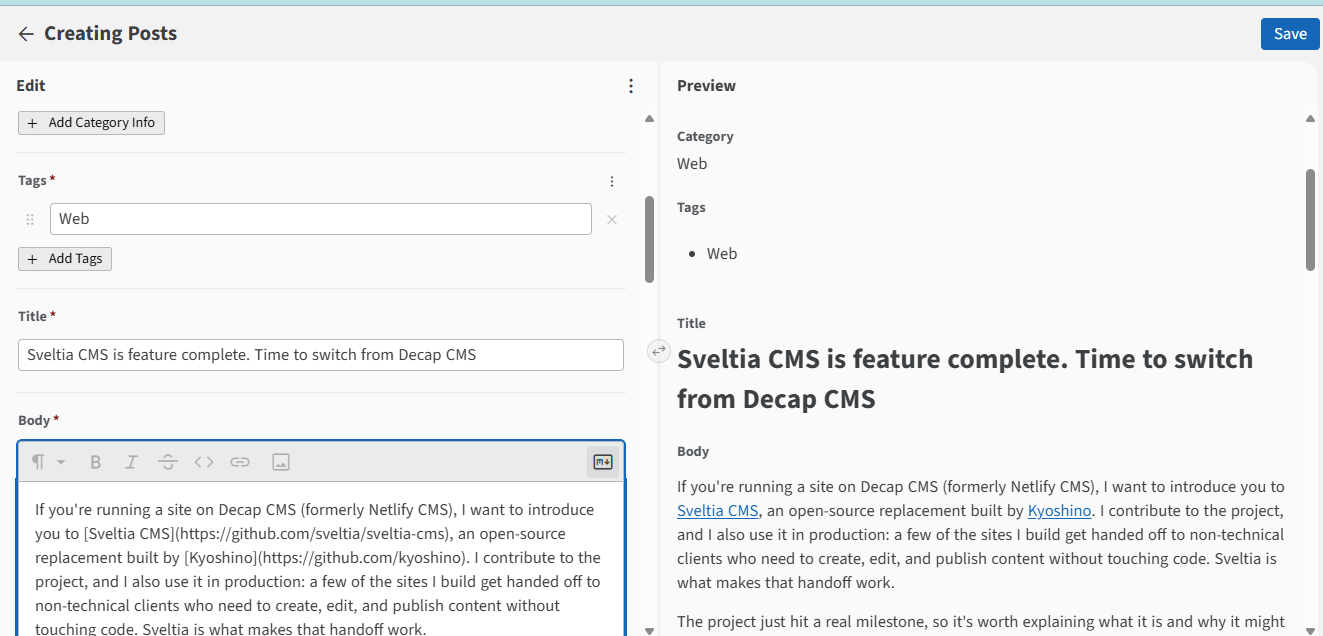
A content management system lets someone update a website's content, text, images, pages, through forms and an editor, without writing code or touching the underlying files. If you've used WordPress to write a blog post, you've used a CMS. Sveltia (like Decap and Netlify CMS before it) is a Git-based CMS: content lives as files in a Git repository, but the person editing it just sees a normal interface such as when posting to social media. For example here is a screenshot of myself adding this post you are reading now to my website:
The role of Git-based content management
A content management system allows editors to update page copy, media files, and taxonomy tags through structured forms without touching raw code or repository files. Traditional solutions like WordPress rely on a dynamic backend paired with an external database such as MySQL.
Git-based content management takes a different path. Your Markdown files, YAML data, and media assets stay inside your Git repository alongside your application code. When an editor logs into the CMS, the client-side single-page application commits changes directly to GitHub, GitLab, or Gitea over REST or GraphQL APIs.
Decap CMS pioneered this model under Netlify. Yet development ground to a near-total halt after Netlify transferred ownership. Outstanding bug reports accumulated without resolution, bundle sizes grew unwieldy, and modern Git platform features remained unsupported.
Why Sveltia CMS started
Netlify CMS was a popular open-source Git-based CMS until it was abandoned. It got revived as Decap CMS under new maintainers, but development stalled and long-standing issues sat untouched for years.
Sveltia CMS started with two goals: match Netlify/Decap CMS closely enough that switching is easy, and fix as many of the issues that piled up on Netlify/Decap CMS as possible.
Sveltia CMS emerged with two distinct objectives:
- Replicate the Netlify and Decap CMS configuration API accurately so existing sites can transition without rewriting schemas.
- Resolve the deep backlog of upstream bugs, race conditions, memory leaks, and missing conveniences that Decap left unaddressed.
The first objective is officially complete.
Every essential Decap capability is implemented and active in Sveltia CMS. The remaining omitted items are deprecated routines or legacy Netlify quirks that no longer fit modern web standards.
The final structural milestones shipped over the past few weeks:
- Editorial Workflow: Draft, in-review, and ready states map directly to pull requests and branches, enabling full editorial review pipelines.
- Open Authoring: External contributors can submit content proposals via automated fork pull requests without needing write permissions to the upstream repository.
- Deploy Previews: Direct integration with CI status checks from Cloudflare Pages, Vercel, Netlify, and GitHub Actions shows live preview URLs right in the entry pane.
- Nested Collections: Complete support for arbitrary tree hierarchies, subdirectories, and nested routing in static site generators.
- Internationalization (i18n): Field-level and file-level translation modes paired with full UI localization into more than 25 languages contributed by the community.
Architectural advantages over Decap CMS
Sveltia CMS is not a simple fork or reskin of Decap CMS. It is a ground-up rewrite using Svelte and modern browser web standards. This rewrite provides immediate technical benefits:
Performance and bundle weight
Decap CMS relies on older React versions, heavy Redux state trees, and legacy Immutable.js data structures. Its minified bundle exceeds 3 MB of JavaScript over the wire, resulting in noticeable parse lag on slower connections and mobile devices.
Sveltia CMS ships as a single compiled bundle that clocks in around 400 KB gzipped. The interface loads instantaneously, handles large collections containing thousands of Markdown files without UI freezing, and renders complex nested object forms smoothly.
Native modern authentication
Decap CMS required third-party OAuth proxies or specialized Netlify Identity setups. Sveltia CMS supports native GitHub personal access tokens, Git credential workflows, and seamless Cloudflare Workers or serverless OAuth authenticators that run on free tiers.
Rich asset handling
Uploading images in Decap frequently triggered repository bloat because assets were committed raw without optimization. Sveltia integrates on-the-fly client-side image transformations, letting you define automatic WebP conversions, quality presets, and custom dimension constraints directly inside your field options.
How to migrate in two minutes
Because Sveltia CMS was designed as an in-place alternative, migrating an existing Decap CMS installation takes minimal effort.
1. Update the admin HTML wrapper
Open your admin entry point (admin/index.html in Jekyll or your static output directory). Replace the Decap CMS script tag with the Sveltia CMS CDN bundle:
<!DOCTYPE html>
<html lang="en">
  <head>
    <meta charset="utf-8" />
    <meta name="viewport" content="width=device-width, initial-scale=1.0" />
    <meta name="robots" content="noindex" />
    <title>Content Manager</title>
  </head>
  <body>
    <!-- Sveltia CMS Bundle -->
    <script src="https://unpkg.com/@sveltia/cms/dist/sveltia-cms.js"></script>
  </body>
</html>
Ensure you remove any external stylesheet tags targeting netlify-cms.css or decap-cms.css. Sveltia encapsulates its styles within the component bundle.
2. Validate your existing config
Sveltia CMS reads your existing admin/config.yml directly. To enable instant IDE validation and schema hinting, ensure the schema declaration is present at the top of admin/config.yml:
# yaml-language-server: $schema=https://unpkg.com/@sveltia/cms/schema/sveltia-cms.json

backend:
  name: github
  repo: your-username/your-repo
  branch: main

media_folder: "assets/images"
public_folder: "/assets/images"

collections:
  - name: "posts"
    label: "Posts"
    folder: "_posts"
    create: true
    slug: "---"
    fields:
      - { label: "Title", name: "title", widget: "string" }
      - { label: "Publish Date", name: "date", widget: "datetime" }
      - { label: "Body", name: "body", widget: "markdown" }
Your existing collection structure, field widgets (string, markdown, list, object, relation, datetime, image), and filter rules will parse immediately.
Adoption and adoption trajectory
Over 530 production sites currently feature in the official Sveltia showcase. More than 160 of those repositories migrated directly from Netlify or Decap CMS.
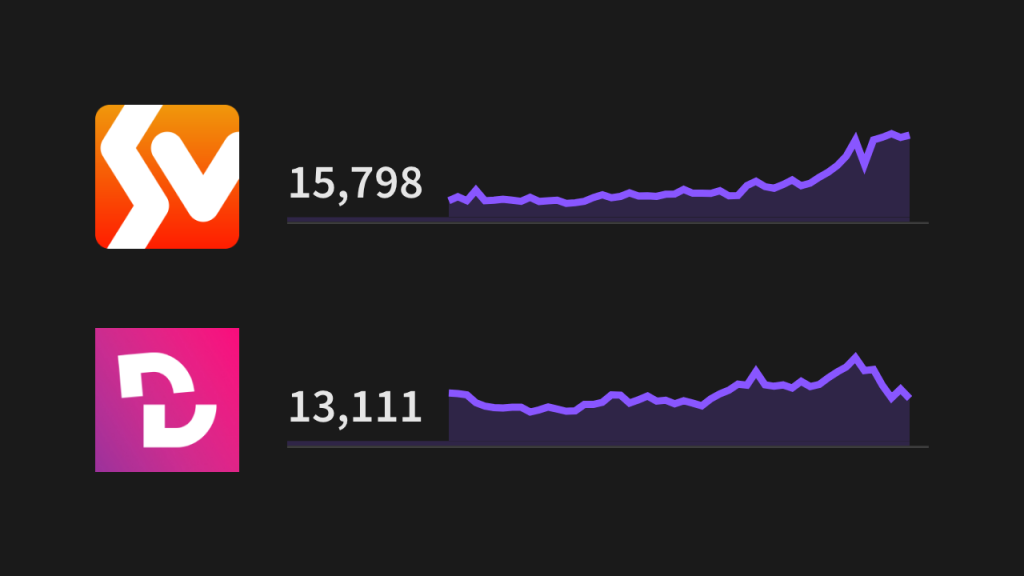
Adoption has accelerated beyond the upstream codebase. Weekly downloads on npm regularly surpass Decap CMS:
Developers running Astro, Hugo, Eleventy, Next.js, and Jekyll are replacing legacy CMS scripts with Sveltia to cut maintenance overhead and deliver faster editing experiences to their teams.
Tackling the upstream backlog
With full Decap feature parity reached, project maintainer Kyoshino has directed engineering focus entirely to the second goal: systematically fixing Decap and Netlify CMS issues.
To date, Sveltia has resolved 335 reported Netlify/Decap issues, which amounts to over 765 unique tickets once upstream duplicates and related bug variations are factored in. The roadmap targets:
- Version 1.0 Milestone: 350 upstream issues solved (800 including duplicates).
- Long-term Scope: 450 upstream issues solved (1,000 including duplicates), alongside dedicated multi-repository support and offline Git synchronization.
Supporting the project
Sveltia CMS is open-source software under the MIT license, driven primarily by one dedicated maintainer with contributions from the community. If you build sites for paying clients or rely on Sveltia to manage corporate blogs, consider sponsoring Kyoshino on GitHub.
For teams transitioning from Decap CMS, filing issue reports, contributing localizations, or sharing migration feedback helps solidify the Git-based CMS ecosystem for everyone.
Original milestone announcement: github.com/sveltia/sveltia-cms/discussions/957
Disclaimer: I contribute to the Sveltia CMS project on Github in seen and unseen ways so naturally, I am extremely excited about its progress.
Related Concepts & Posts
The following cards provide further definitions of concepts discussed above, and possible links to related posts.

Sveltia CMS Repository
Lightweight, Git-based headless CMS built as a modern, high-speed replacement for Netlify CMS and Decap CMS.
View on GitHub
Sveltia Official Documentation
Complete configuration schemas, backend authenticators, field widgets, and framework migration guides.
Read DocumentationMigration Discussion
Milestone breakdown detailing the final feature implementations, closed upstream issues, and roadmap goals.
Read Announcement