
SpaceX Did It Again: Precision Engineering on Display
Just when you thought Elon Musk and the team at SpaceX couldn’t top themselves, they proved once again that rapid aerospace iteration rewrites what is possible. SpaceX successfully guided a 33-story tall Super Heavy booster back from space at supersonic speeds and caught it mid-air using the giant mechanical “chopstick” arms of the Mechazilla launch tower at Starbase, Texas.
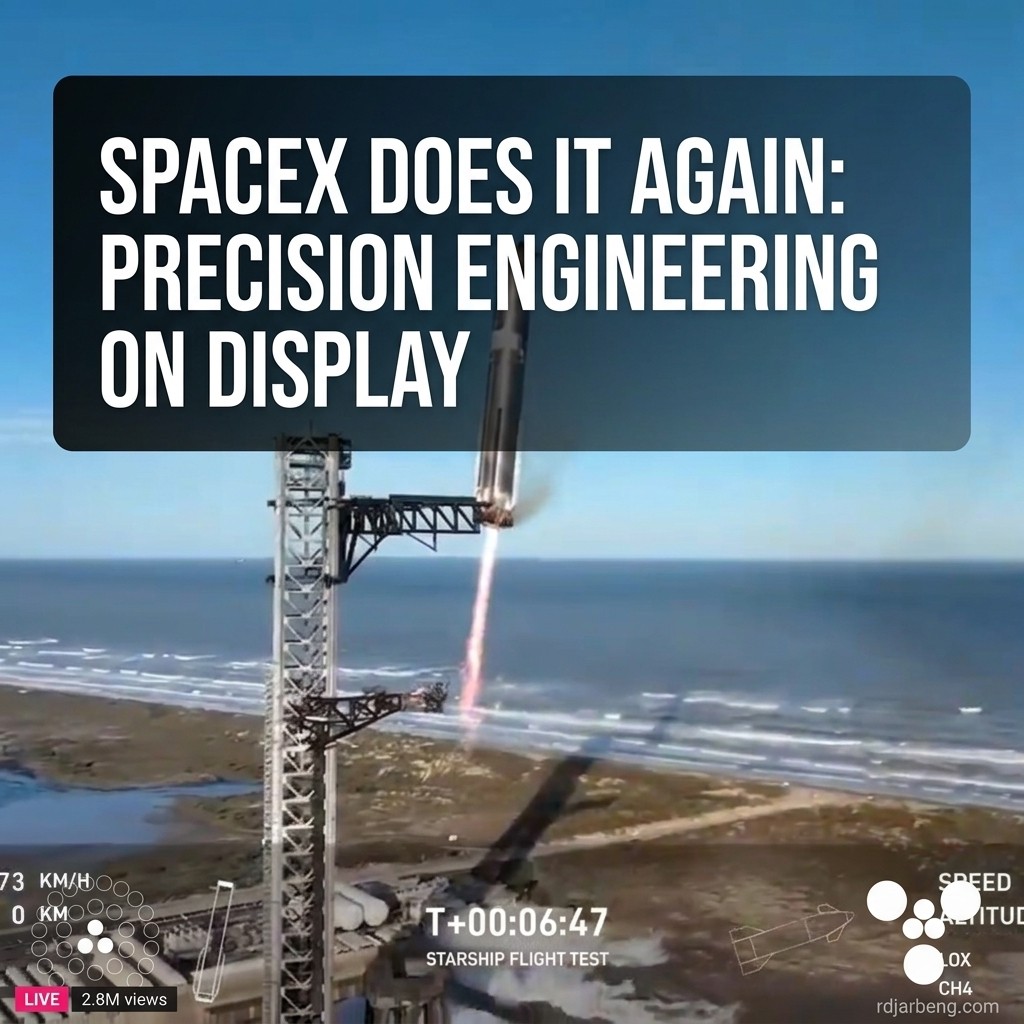
Catching a rocket booster returning from space is not just a sensational spectacle for social media. It represents a fundamental breakthrough in mechanical, control, and structural engineering that pushes space travel closer to true operational reusability.
The Mechanical Marvel of Mechazilla
For decades, rocket design assumed a rigid tradeoff: if you want a stage to land safely, you must equip it with heavy structural landing legs. However, every kilogram of landing hardware attached to a rocket booster degrades performance, reducing the payload capacity that can actually reach orbit.
SpaceX bypassed this physical constraint by moving the landing apparatus entirely off the vehicle and onto the launch tower:
- Mass Optimization: Removing heavy landing legs reduces the dry mass of the Super Heavy booster, freeing up critical margin for orbital payload mass.
- Immediate Turnaround: Landing the booster directly back onto the launch mount allows technicians to inspect, refuel, and restack the vehicle in a fraction of the time traditional recovery barges or landing pads require.
- Structural Load Distribution: The booster is caught using precision hard points located beneath its grid fins, transferring structural decelerating loads through reinforced load paths built directly into the tower.
Precision Guidance and Supersonic Retro-Propulsion
Returning a 250-ton stainless steel cylinder from upper-atmospheric velocities down to zero velocity relative to two moving steel arms requires extreme real-time control:
- Grid Fin Aerodynamic Steering: Massive titanium grid fins positioned near the top of the booster actuate continuously to maneuver through hypersonic and supersonic atmospheric entry phases.
- Raptor Engine Gimballing: A cluster of center Raptor 3 engines ignite during the landing burn, dynamic-gimballing to counteract lateral winds and eliminate residual horizontal momentum.
- Sub-Meter Navigation Accuracy: Millisecond control loops process real-time telemetry, GPS, and optical tracking data to guide the booster between the Mechazilla arms with sub-meter positioning tolerances.
Redefining the Economics of Spaceflight
When I covered the first catch of the Super Heavy booster, many viewed the initial success as a once-in-a-lifetime engineering miracle. Repeating the catch proves that this capability is a repeatable manufacturing and operational workflow.
By eliminating expendable hardware and minimizing turnaround times between flights, full reusability dramatically lowers the cost per kilogram to orbit, laying the technical foundation for interplanetary transport.
High-Resolution Launch Catch Footage
Check out the incredible moment captured during the recovery test:
— Elon Musk (@elonmusk) January 16, 2025

Related Concepts & Posts
The following cards provide further definitions of concepts discussed above, and possible links to related posts.
SpaceX Official Site
Official news and launch updates from SpaceX.
Visit SpaceX.comStarship Vehicle Overview
Detailed architecture of the Starship and Super Heavy booster system.
Explore StarshipBooster Catch Video on X
High-resolution video footage of the Super Heavy booster catch shared by Elon Musk.
Watch on X
