Victor B. Lawrence: The Ghanaian Engineer Who Connected the World
When you connect to the internet today, streaming high-definition video, joining crystal-clear video calls, or simply browsing at lightning speeds, you are benefiting from the life’s work of a pioneer you may have never heard of: Dr. Victor B. Lawrence. A Ghanaian-born electrical engineer, his innovations in digital signal processing (DSP) and data communications were instrumental in the world’s transition from clunky analog systems to the high-speed digital networks we rely on today.
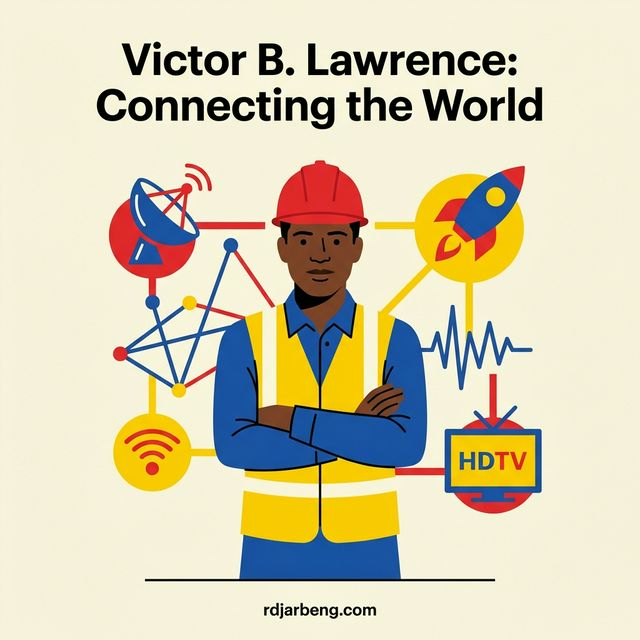
But who exactly is Dr. Lawrence, and why is his story so profoundly relevant, especially for young African innovators? His journey from Accra to the highest echelons of Bell Laboratories is not just a testament to academic brilliance; it is a blueprint for how technical expertise combined with visionary leadership can literally connect continents.
Who is Victor B. Lawrence, and What Has He Achieved?
Born in Accra, Ghana, in 1945, Victor B. Lawrence nurtured an early passion for science and technology, attending the prestigious Achimota School. He later moved to the United Kingdom to pursue his studies at the Imperial College of Science and Technology, earning his Bachelor’s, Master’s, and ultimately a Ph.D. in electrical engineering in 1972.
In this interview shared by his high school, Achimota School, Dr. Lawrence reflects on his journey, discussing his search for scholarships, his transition from Imperial College to Bell Labs, and his remarkable early work on the communication technologies used by astronaut John Glenn when he orbited the Earth:
Lawrence’s most recognizable achievements occurred during his incredible three-decade tenure at Bell Laboratories (later AT&T Bell Labs). He didn’t just participate in the telecommunications revolution; he led it. Here are some of his most monumental contributions:
- Pioneering Modem Technologies: Lawrence was the lead engineer and architect behind AT&T’s first 2400-bit/s full-duplex modem for the Public Switched Telephone Network. His work paved the way for subsequent high-speed modem standards (like V.34 and V.90), making widespread, low-cost data communications a global reality.
- Advancing Digital Signal Processing (DSP): He made seminal contributions to DSP algorithms, which are essential mathematical processes that allow computers to understand and manipulate audio and video data. His work on “bias-less rounding arithmetic” stabilized digital signal processors, a crucial leap in moving telecommunications from analog to digital.
- High-Definition Video and Audio: Lawrence led teams that developed digital video technologies critical for HDTV. He also contributed hardware for the Sirius Radio Satellite system.
For his groundbreaking innovations, he has received numerous honors, including induction into the National Inventors Hall of Fame (2016), the IEEE Simon Ramo Medal (2007), and the prestigious National Medal of Technology and Innovation (laureate in 2024).
Bridging the Gap: Fiber Optics and Connecting Africa
While his inventions laid the foundation for global internet architecture, Lawrence never forgot his roots and the importance of connecting the continent of his birth. One of his most passionate endeavors was tackling the digital divide.
In the 1990s, he spearheaded early efforts in the “Africa One” project, a massively ambitious initiative aimed at laying a 17,000-kilometer underwater fiber optic cable network around the African continent. This was a pivotal moment for Africa, reducing reliance on expensive satellite connections and providing the high-speed infrastructure necessary for economic growth, education, and global participation.
Lawrence also served as an advisor on Information and Communication Technology (ICT) for the South African government, shaping telecommunications policies that have continued to impact the continent today. His relentless advocacy for global internet access highlighted his core belief: massive bandwidth and global connectivity are drivers of opportunity.
What Can Young Africans Learn from Him?
The story of Victor B. Lawrence offers profound lessons for the next generation of engineers, technologists, and leaders across Africa and beyond:
- Innovation Begins at Home (But Can Change the World): Lawrence’s early education in Ghana laid the foundation for his global impact. Young Africans should realize that world-class talent can be nurtured anywhere. The problems you observe locally can often inspire solutions with global applications.
- Master the Fundamentals: Lawrence didn’t just build products; he advanced the underlying science of his field (such as his doctoral work in digital filter design). Deep, fundamental understanding is what allows you to build the “first” of something, rather than just the “next” version.
- Technology is a Tool for Empowerment: His advocacy for connecting Africa via fiber optics shows that engineering isn’t just about building cool gadgets. It’s about infrastructure that lifts people out of poverty and connects them to opportunities.
- Mentorship is Vital: Lawrence has consistently championed STEM education. His belief in being a “strong shoulder for others to stand on” is a reminder that success is best measured by how many people you lift up along the way.
Following in the footsteps of Dr. Lawrence means seeing technology not just as an industry, but as a calling to build a more connected, equitable world. His legacy proves that African talent has always been at the heart of global technological leaps, and will continue to be for generations to come. Quote from Victor Lawrence:
“You have to stand on somebody’s shoulder before you can see far. And so, it’s very important that I have a strong shoulder for others to stand on, so they can see far and they can do greater things.”
Want to dive deeper? Dr. Lawrence continues his work today as a Research Professor and Director of the Center for Intelligent Networked Systems (iNetS) at the Stevens Institute of Technology. You can read more about his remarkable career and patents on the National Inventors Hall of Fame website.