The Internet’s Magic Number: Why Are There Only 13 DNS Root Servers For The Whole World?
If you are studying for a networking or cloud certification (like AWS Solutions Architect), you will eventually hit a question that stops you in your tracks:
“How many DNS Root Servers are there?” Answer: 13.
At first glance, this sounds terrifying. We have billions of devices, trillions of websites, and the entire global economy running on the internet. How can the whole thing rely on just 13 computers?
The answer lies in a fascinating mix of 1980s history, hard math, and a clever routing trick called “Anycast.” Here is everything you need to know about the 13 Root Servers—and why the internet is stronger than it looks.
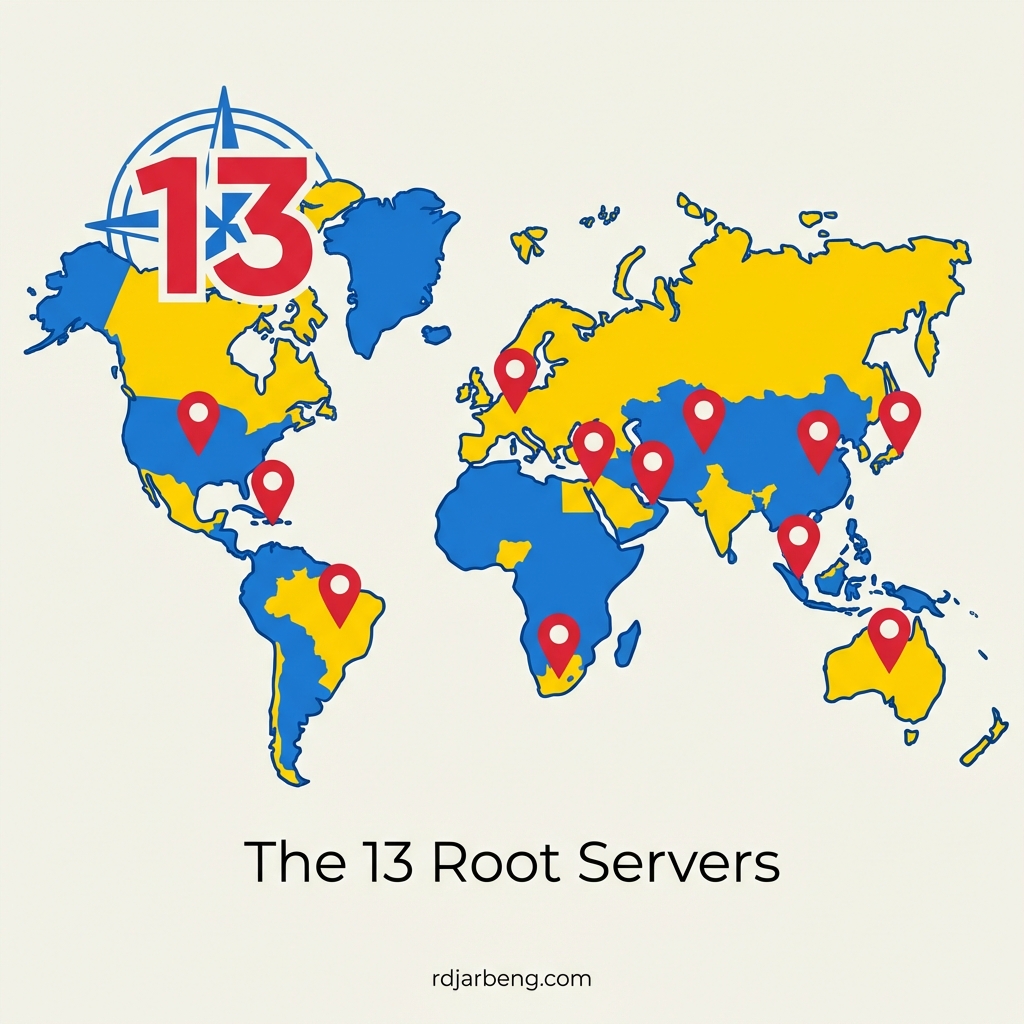
1. The History Lesson: The 512-Byte Box
To understand why we have 13 servers, you have to go back to the early days of the internet (IPv4).
In the 1980s, the engineers building the Domain Name System (DNS) faced a strict physical constraint: The UDP Packet Limit.
Data travels across the internet in “packets.” Back then, the maximum safe size for a UDP packet (the protocol used for fast, lightweight messages) was 512 bytes. As detailed in RFC 1035, if a packet was bigger than that, old routers would chop it into pieces (fragmentation), causing data loss, or force the connection to switch to TCP (which is reliable but much slower).
The Math Problem
Engineers had to fit the “map” of the internet’s root into that tiny 512-byte box.
- They needed to list the server Names (e.g.,
a.root-servers.net). - They needed the IP Addresses.
- They needed protocol overhead (headers, flags, etc.).
When you added up the byte cost for the headers and the addresses, they hit a hard limit. They could fit exactly 13 addresses into the packet before it overflowed.
So, the limit isn’t political or arbitrary; it’s basically the digital equivalent of fitting people into a small elevator. The 14th person just wouldn’t fit.
2. The Myth of the “Kill Switch”
A common fear is that if these 13 servers are destroyed, the internet turns off. This fear is amplified when you look at who runs them.
The 13 IP addresses (A through M) are managed by 12 different organizations (Verisign manages two). The list reads like a “Who’s Who” of the US establishment:
- NASA (Yes, the space agency manages the E-Root)
- The US Army Research Lab
- The US Department of Defense
- University of Southern California
- University of Maryland
It looks incredibly US-centric. This leads to the “Doomsday Scenario”: What if the US Government decides to shut off the internet? Or what if a disaster takes the US offline?
This is where the distinction between Logical and Physical becomes crucial.
3. The “Cheat Code”: Anycast
Here is the secret: There are not 13 servers. There are 13 IP Addresses.
In reality, there are thousands of physical servers scattered around the globe (over 1,900 sites as of 2026). They use a routing technology called Anycast.
How Anycast Works
Imagine you call the emergency number 911 (or 112).
- There is only one phone number.
- But thousands of operators exist across the country.
- The telephone network automatically routes your call to the closest call center to your physical location.
The Root Servers work the exact same way.
- If you are in Kigali, Rwanda, and your computer queries the “E-Root” (managed by NASA), your request doesn’t travel under the ocean to Washington D.C.
- Instead, it travels to a local data center in Kigali where NASA has placed a physical copy of the server. (You can check the interactive map of all root servers here).
Why this is “Doomsday Proof”
If the entire North American continent went dark tomorrow:
- Decentralization: The physical servers in Europe, Africa, and Asia would keep running because they have a local copy of the database (the “Root Zone”).
- Jurisdiction: While many operators are US-based, others are international. Netnod is in Sweden, RIPE is in the Netherlands, and WIDE is in Japan.
- Result: Your local internet would keep resolving DNS queries just fine.
4. Why Does This Matter for AWS?
If you are studying for a cloud certification, you won’t be managing root servers. However, understanding them is the key to understanding Route 53.
AWS Route 53 is an “Authoritative” DNS service. It uses the exact same principles as the Root Servers to keep your application online:
- High Availability: Just like the Root Servers, AWS Route 53 uses Anycast. When you create a domain, AWS propagates that record to thousands of servers globally.
- Latency: By understanding that users connect to the closest server (not a central master server), you understand how to lower latency for your customers.
- TTL (Time To Live): The reason DNS changes take time to “propagate” is that the Root and TLD servers cache information. You are at the mercy of the hierarchy.
Summary
The “13 Root Servers” are a relic of 1980s packet limits, but they have evolved into one of the most robust distributed systems on Earth.
- The Limit: 512 Bytes (UDP Packet Size).
- The Managers: 12 organizations (Heavy US military/university presence + International partners).
- The Reality: Thousands of physical servers using Anycast to ensure that even if nations go offline, the network stays up.
So, the next time you browse the web, thank the engineers who figured out how to fit the entire world into 512 bytes.