Youtube

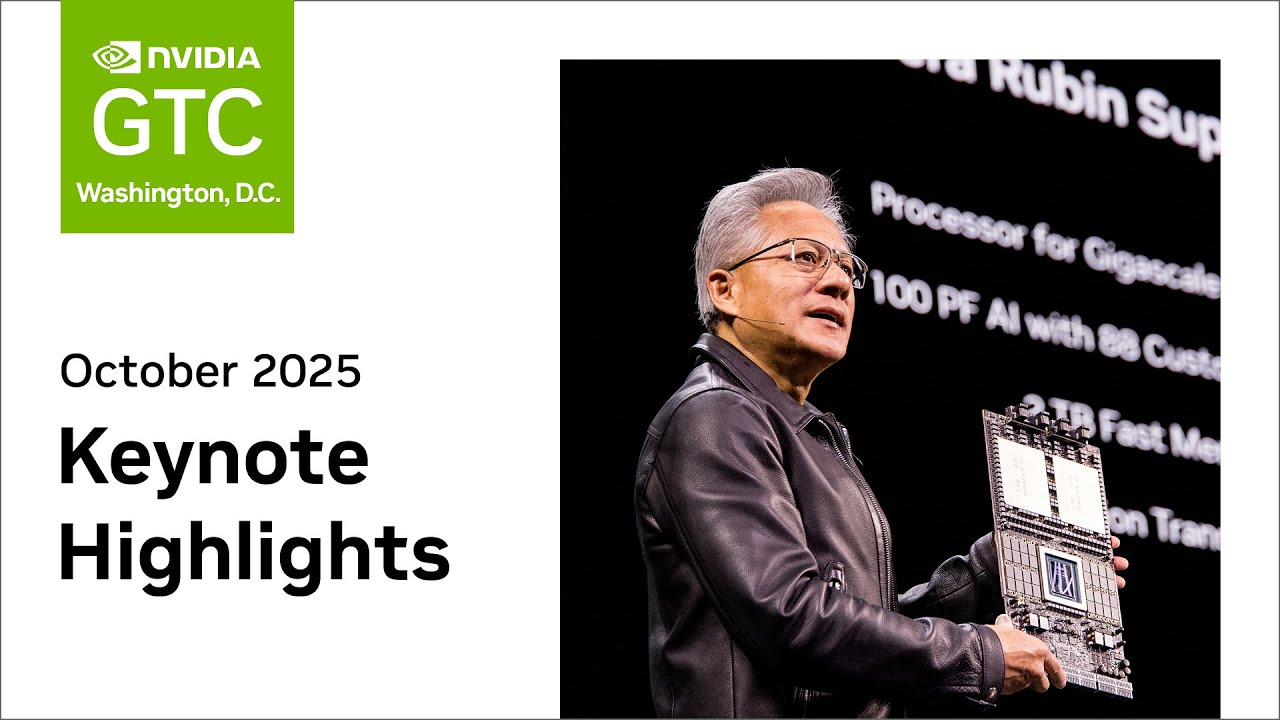
This video features Jensen Huang’s keynote highlights from NVIDIA GTC in Washington, D.C., focusing on the pivotal role of accelerated computing and AI in national security, telecommunications, and American manufacturing. Huang positions the current era as a turning point where the GPU and CUDA programming model—technologies NVIDIA has developed for 30 years—have become the essential “lifeblood” of the modern economy.
The Era of Accelerated Computing
- A 30-Year Journey: Jensen Huang highlights that NVIDIA has been advancing accelerated computing for three decades, inventing the GPU and the CUDA programming model [00:10].
- The AI Moment: He declares that the moment for accelerated computing has arrived, calling it the “treasure” of the company [00:17].
Strategic Partnerships & Infrastructure
- 6G & Telecommunications: NVIDIA is partnering with Nokia to place America at the center of the next revolution in 6G, utilizing the NVIDIA Arc platform [00:36].
- Quantum Computing: A new interconnect called NVQ Link was announced, supported by 17 different quantum industry companies to assist with quantum computer control, calibration, and error correction [00:45].
- AI Supercomputers: The Department of Energy is partnering with NVIDIA to build seven new AI supercomputers aimed at advancing national science [01:08].
The “AI Factory” & Domestic Manufacturing
- Economic Growth: Huang discusses how AI will augment labor and address segments of the economy previously untouched by IT [01:20].
- AI Factories: He distinguishes modern data centers from the past, calling them “AI Factories” because they are designed to run one thing: AI [01:27].
- Manufacturing: Huang proudly notes that “we are manufacturing in America again” [01:36].
Future Mobility & Open Source
- Uber Partnership: A collaboration with Uber was announced to integrate NVIDIA Drive Hyperion cars into a global network for robo-taxis [01:49].
- Open Source Leadership: NVIDIA is dedicating itself to ensuring the U.S. leads in open-source AI to support domestic startups [01:43].
What’s so interesting about this?
It is particularly interesting because of the shift in terminology from “data centers” to “AI factories,” reflecting a new industrial revolution where intelligence is the primary manufactured product. The presentation also highlights a strong emphasis on national sovereignty, asserting that the United States must lead in both domestic manufacturing and open-source development to support the next generation of startups and scientific advancement.
Major Announcements
Major announcements included a partnership with the Department of Energy to build seven new AI supercomputers and a collaboration with Nokia to place the U.S. at the center of 6G technology via the NVIDIA Arc platform. Additionally, NVIDIA unveiled the NVQ Link to support the quantum computing industry and a partnership with Uber to integrate NVIDIA Drive Hyperion into a global robo-taxi network.
This video features Jensen Huang’s keynote highlights from NVIDIA GTC in Washington, D.C., focusing on the pivotal role of accelerated computing and AI in national security, telecommunications, and American manufacturing. Huang positions the current era as a turning point where the GPU and CUDA programming model—technologies NVIDIA has developed for 30 years—have become the essential “lifeblood” of the modern economy.
The Era of Accelerated Computing
- A 30-Year Journey: Jensen Huang highlights that NVIDIA has been advancing accelerated computing for three decades, inventing the GPU and the CUDA programming model [00:10].
- The AI Moment: He declares that the moment for accelerated computing has arrived, calling it the “treasure” of the company [00:17].
Strategic Partnerships & Infrastructure
- 6G & Telecommunications: NVIDIA is partnering with Nokia to place America at the center of the next revolution in 6G, utilizing the NVIDIA Arc platform [00:36].
- Quantum Computing: A new interconnect called NVQ Link was announced, supported by 17 different quantum industry companies to assist with quantum computer control, calibration, and error correction [00:45].
- AI Supercomputers: The Department of Energy is partnering with NVIDIA to build seven new AI supercomputers aimed at advancing national science [01:08].
The “AI Factory” & Domestic Manufacturing
- Economic Growth: Huang discusses how AI will augment labor and address segments of the economy previously untouched by IT [01:20].
- AI Factories: He distinguishes modern data centers from the past, calling them “AI Factories” because they are designed to run one thing: AI [01:27].
- Manufacturing: Huang proudly notes that “we are manufacturing in America again” [01:36].
Future Mobility & Open Source
- Uber Partnership: A collaboration with Uber was announced to integrate NVIDIA Drive Hyperion cars into a global network for robo-taxis [01:49].
- Open Source Leadership: NVIDIA is dedicating itself to ensuring the U.S. leads in open-source AI to support domestic startups [01:43].
What’s so interesting about this?
It is particularly interesting because of the shift in terminology from “data centers” to “AI factories,” reflecting a new industrial revolution where intelligence is the primary manufactured product. The presentation also highlights a strong emphasis on national sovereignty, asserting that the United States must lead in both domestic manufacturing and open-source development to support the next generation of startups and scientific advancement.
Major Announcements
Major announcements included a partnership with the Department of Energy to build seven new AI supercomputers and a collaboration with Nokia to place the U.S. at the center of 6G technology via the NVIDIA Arc platform. Additionally, NVIDIA unveiled the NVQ Link to support the quantum computing industry and a partnership with Uber to integrate NVIDIA Drive Hyperion into a global robo-taxi network.
NVIDIA GTC Washington D.C.: Jensen Huang’s Vision for the 'AI Factory'
March 11, 2026




Veritasium On Why Democracy Is Mathematically Impossible
The video explains why there are always 2 major contestants in an election and why inherent biases lead to the voting choices we have today. If is filled with examples from History and considers/advocates for a ranked voting system.
Watch the video to find out.
The video explores the mathematical challenges and paradoxes inherent in different voting systems, illustrating why a “perfect” democracy is mathematically impossible when using ranked-choice methods.
The Flaws of “First Past the Post”
- How it Works: Voters pick one favorite candidate, and the person with the most votes wins [00:46].
- The Problems: This system frequently results in a winner who did not receive the majority of the popular vote [01:48]. It also causes the “spoiler effect,” where similar candidates steal votes from each other (e.g., Ralph Nader in the 2000 US Presidential Election). This effectively incentivizes strategic voting over honest preference, which eventually leads to a two-party system—a phenomenon known as Duverger’s Law [03:17].
Ranked Choice and the Condorcet Paradox
- Instant Runoff (Ranked Choice Voting): Voters rank their preferences. If no one gets a majority, the lowest candidate is eliminated and their votes go to those voters’ second choices [04:51]. While it encourages more cordial campaigns, it can create a bizarre mathematical anomaly where a candidate performing worse in the first round can actually cause them to win the overall election [06:59].
- Condorcet’s Method: Proposed in 1785, this method suggests the winner should be the candidate who beats every other candidate in a head-to-head match-up [09:31].
- The Paradox: This leads to a rock-paper-scissors scenario known as Condorcet’s Paradox. For example, a group might prefer Burgers over Pizza, and Pizza over Sushi, but also prefer Sushi over Burgers, resulting in an endless loop with no clear winner [11:09].
Arrow’s Impossibility Theorem
In 1951, Kenneth Arrow outlined five fundamental and reasonable conditions for a fair ranked voting system [12:19]:
- Unanimity: If everyone prefers A over B, society must prefer A over B.
- No Dictatorship: No single person’s vote should override the preferences of everyone else.
- Unrestricted Domain: The system must consistently produce a valid conclusion for society based on all ballots.
- Transitivity: If A beats B, and B beats C, then A must beat C.
- Independence of Irrelevant Alternatives: Introducing a new option shouldn’t change the relative ranking of the existing options.
Arrow mathematically proved that satisfying all five of these conditions in a ranked voting system with three or more candidates is impossible, a discovery that earned him a Nobel Prize in Economics [14:06].
A Potential Solution: Rated Voting Systems
- Arrow’s theorem only applies to ordinal (ranked) voting systems.
- A mathematical workaround is using rated voting systems, such as Approval Voting. Instead of ranking candidates, voters simply tick all the candidates they approve of [19:50].
- Research shows this method increases voter turnout, prevents the spoiler effect, and successfully avoids the paradoxes outlined by Arrow’s theorem [20:13].
Veritasium On Why Democracy Is Mathematically Impossible
The video explains why there are always 2 major contestants in an election and why inherent biases lead to the voting choices we have today. If is filled with examples from History and considers/advocates for a ranked voting system.
Watch the video to find out.
The video explores the mathematical challenges and paradoxes inherent in different voting systems, illustrating why a “perfect” democracy is mathematically impossible when using ranked-choice methods.
The Flaws of “First Past the Post”
- How it Works: Voters pick one favorite candidate, and the person with the most votes wins [00:46].
- The Problems: This system frequently results in a winner who did not receive the majority of the popular vote [01:48]. It also causes the “spoiler effect,” where similar candidates steal votes from each other (e.g., Ralph Nader in the 2000 US Presidential Election). This effectively incentivizes strategic voting over honest preference, which eventually leads to a two-party system—a phenomenon known as Duverger’s Law [03:17].
Ranked Choice and the Condorcet Paradox
- Instant Runoff (Ranked Choice Voting): Voters rank their preferences. If no one gets a majority, the lowest candidate is eliminated and their votes go to those voters’ second choices [04:51]. While it encourages more cordial campaigns, it can create a bizarre mathematical anomaly where a candidate performing worse in the first round can actually cause them to win the overall election [06:59].
- Condorcet’s Method: Proposed in 1785, this method suggests the winner should be the candidate who beats every other candidate in a head-to-head match-up [09:31].
- The Paradox: This leads to a rock-paper-scissors scenario known as Condorcet’s Paradox. For example, a group might prefer Burgers over Pizza, and Pizza over Sushi, but also prefer Sushi over Burgers, resulting in an endless loop with no clear winner [11:09].
Arrow’s Impossibility Theorem
In 1951, Kenneth Arrow outlined five fundamental and reasonable conditions for a fair ranked voting system [12:19]:
- Unanimity: If everyone prefers A over B, society must prefer A over B.
- No Dictatorship: No single person’s vote should override the preferences of everyone else.
- Unrestricted Domain: The system must consistently produce a valid conclusion for society based on all ballots.
- Transitivity: If A beats B, and B beats C, then A must beat C.
- Independence of Irrelevant Alternatives: Introducing a new option shouldn’t change the relative ranking of the existing options.
Arrow mathematically proved that satisfying all five of these conditions in a ranked voting system with three or more candidates is impossible, a discovery that earned him a Nobel Prize in Economics [14:06].
A Potential Solution: Rated Voting Systems
- Arrow’s theorem only applies to ordinal (ranked) voting systems.
- A mathematical workaround is using rated voting systems, such as Approval Voting. Instead of ranking candidates, voters simply tick all the candidates they approve of [19:50].
- Research shows this method increases voter turnout, prevents the spoiler effect, and successfully avoids the paradoxes outlined by Arrow’s theorem [20:13].
Veritasium on Why Democracy Is Mathematically Impossible
March 4, 2026

![Smith & Thell - Hotel Walls: A Visual Metaphor for Transience [with Lyrics]](/assets/images/videos/youtube_ELuH1TVQ0Ak.jpg)
![Smith & Thell - Hotel Walls (Acoustic Version) [with Lyrics]](/assets/images/videos/youtube_Rnj3ps7V7D4.jpg)