
Huffman Coding Solves an Open Compression Problem
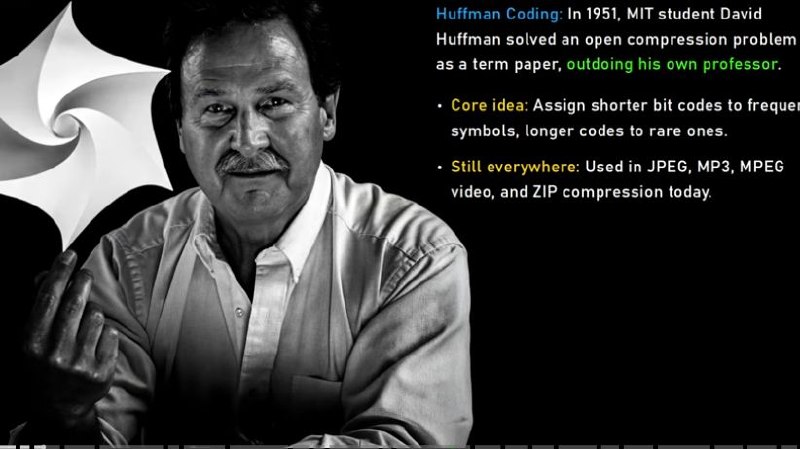
Huffman coding solves an open compression problem
From the Lex Fridman podcast Huffman Coding: In 1951, MIT student David Huffman solved an open compression problem as a term paper, outdoing his own professor.
Core idea: Assign shorter bit codes to frequent symbols, longer codes to rare ones.
Still everywhere: Used in JPEG, MP3, MPEG video, and ZIP compression today.
This image highlights the history and impact of Huffman Coding in data science:
Origin: Developed by David Huffman in 1951 while he was a student at MIT, fulfilling an assignment that required solving a challenging compression problem.Method: The technique works by assigning shorter binary codes to frequently occurring symbols and longer codes to rarer ones, optimizing data storage.
Modern Use: Huffman coding remains a fundamental component in widespread file formats, including JPEG images, MP3 audio, MPEG video, and ZIP archives
Additional comments:
The history of data science is filled with moments of unexpected brilliance, and the invention of Huffman Coding is a prime example. In 1951, MIT student David Huffman turned a simple term paper assignment into a monumental breakthrough in computer science. By solving a complex problem that had stumped his own professor, he created a method that changed data storage forever. The elegance of his approach lies in its simplicity. The core idea relies on variable length coding: frequently used symbols receive short binary representations, while rare symbols are assigned longer strings. This optimization strategy creates highly efficient data structures. Even today, this foundational algorithm remains an essential pillar of digital technology. We rely on Huffman Coding every time we open a JPEG, stream an MP3, watch an MPEG video, or extract a ZIP file. David Huffman transformed a classroom challenge into a universal standard that continues to power our modern digital world.

![Smith & Thell - Hotel Walls: A Visual Metaphor for Transience [with Lyrics]](/assets/images/videos/youtube_ELuH1TVQ0Ak.jpg)
-Cover.jpg)